
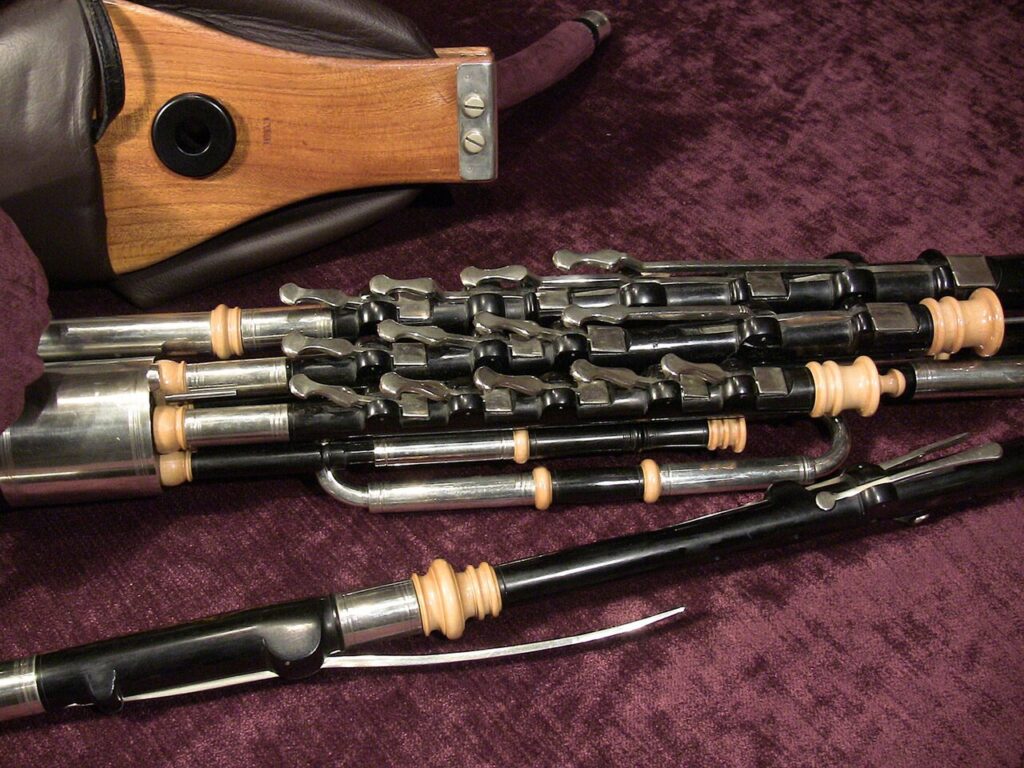
Walk into any serious trad session in Ireland and you might hear a sound that stops you mid-conversation: rich, haunting, capable of both delicate melody and powerful resonance. That’s the uilleann pipes, Ireland’s national bagpipe and one of the most complex musical instruments in the world.
Watch: the latest film
The Irish County Names: What All 32 Mean
Unlike their Scottish cousins, uilleann pipes are played sitting down, powered by a bellows strapped to the elbow rather than mouth-blown. The name itself comes from the Irish word for elbow, uille. But the mechanics are just the beginning of what makes these pipes so extraordinary.
An Instrument With Three Voices
The uilleann pipes consist of three parts working together: the chanter, which plays the melody; the drones, which provide a continuous harmonic background; and the regulators, which add rhythmic chords. A skilled piper controls all three simultaneously, creating music that sounds like it’s coming from multiple instruments at once.
The chanter has a two-octave range and can be played in a chromatic scale, giving pipers far more melodic flexibility than most bagpipes. The regulators, unique to uilleann pipes, are played with the wrist and palm to add harmonic accompaniment. It’s this combination that allows the instrument to move from slow airs that would make you weep to jigs and reels that get your feet moving without warning.
Master pipers like Paddy Keenan, Liam O’Flynn, and Davy Spillane have shown what the instrument can do in the hands of someone who’s devoted years to it. O’Flynn’s work with Planxty and the soundtrack to Riverdance brought the pipes to audiences worldwide. His performance of “The Wounded Huzzar” remains one of the most moving pieces of Irish music ever recorded.
Seven Years to Learn, a Lifetime to Master
There’s a saying among musicians: it takes seven years to learn the uilleann pipes and a lifetime to master them. That’s not an exaggeration. The physical coordination required to manage the bellows, control the bag pressure, finger the chanter, and operate the regulators all at once is formidable.
Traditional pipe makers like Eugene Lambe and Andreas Rogge craft sets that can cost upward of $8,000 to $15,000, and waiting lists stretch for years. Each set is hand-made, individually voiced, and unique. The reeds alone require constant adjustment and care, responding to humidity, temperature, and the player’s technique.
Na Píobairí Uilleann, founded in Dublin in 1968, has become the global center for preserving and promoting the tradition. They run classes, maintain archives, support pipe makers, and organize festivals. Their headquarters on Henrietta Street in Dublin is where serious students come to learn from masters of the craft.
Where to Hear Them Today
If you want to experience uilleann pipes in their natural habitat, certain places in Ireland are known for attracting pipers. The Cobblestone pub in Dublin’s Smithfield area regularly features pipers in its sessions. Matt Molloy’s in Westport, owned by the Chieftains’ flute player, often draws pipe players passing through County Mayo.
The Willie Clancy Summer School, held every July in Milltown Malbay, County Clare, is the premier gathering for uilleann pipers worldwide. For a week, the small village fills with students, concerts, and sessions where you’ll hear some of the finest playing anywhere. Even if you’re not attending classes, visitors are welcome at the evening pub sessions where the music runs late into the night.
In winter, the Temple Bar TradFest in Dublin features uilleann pipe concerts and workshops. The annual Scoil Samhraidh Willie Clancy draws hundreds of pipers, and the music spills out from formal classes into informal sessions throughout the village.
An Instrument Worth Seeking Out
The uilleann pipes carry something essential about Irish music: complexity wrapped in emotion, technical brilliance serving the tune rather than showing off, and a sound that connects directly to something old and unbroken. When a piper settles into a slow air in a quiet pub, the room goes silent. There’s nothing else quite like it.
Whether you hear them in a session, at a festival, or in a concert hall, take the time to really listen. Watch how the piper’s whole body works to create the sound. Notice how the drones anchor everything while the chanter weaves the melody and the regulators add unexpected harmonies. It’s an instrument that rewards attention.
Ready to discover more of Ireland’s music, landscapes, and traditions? Download your free guide The Ireland Bucket List: 25 Places That Will Stop You In Your Tracks at irishvideos.com/subscribe, and watch sessions, landscapes, and stories from across Ireland on the Love Ireland channel on YouTube.