
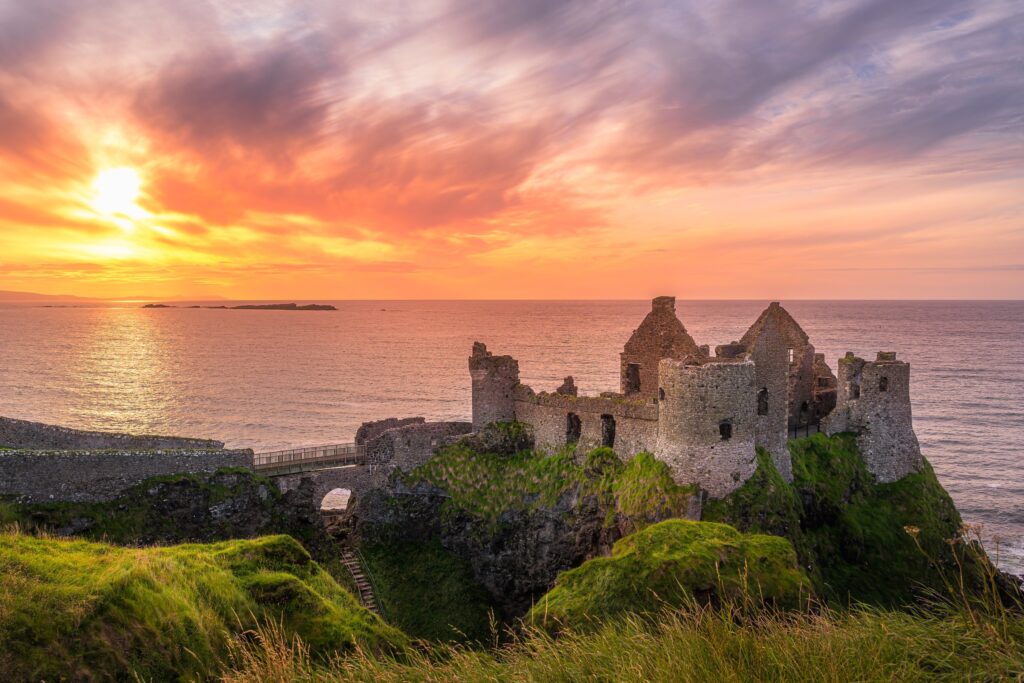
There are castles in Ireland that tell quiet stories of manor life and carefully tended estates. Then there’s Dunluce Castle, clinging to a basalt outcrop on the Antrim coast, where the Atlantic crashes 100 feet below and the wind never stops. This is Ireland at its most dramatic, a place where history and landscape collide with breathtaking force.
Watch: the latest film
Where Do the Most Common Irish Surnames Come From?
Dunluce isn’t just a ruin. It’s a defiant statement, a medieval stronghold that refused to surrender to siege, storm, or the relentless sea. And today, it remains one of the most photographed and captivating sites in Northern Ireland.
A Castle Built on the Edge
Dunluce Castle sits on a narrow headland between two deep chasms, accessible only by a bridge that once was a drawbridge. The site has been fortified since at least the 13th century, but the castle you see today was largely built by the MacDonnell clan in the 16th century, Irish lords with Scottish roots who controlled this stretch of coast for generations.
The location was chosen for defense. Dunluce is nearly impossible to attack from land, and its sheer cliffs made it impregnable from the sea. The MacDonnells ruled here with a mix of ambition and defiance, holding out against English forces and rival clans alike.
Walking through the gatehouse and into the ruined courtyards, you can still sense the castle’s former grandeur. The remains of the Great Hall, kitchens, and living quarters tell the story of a thriving fortress that was once home to one of Ireland’s most powerful families.
The Night the Kitchen Fell Into the Sea
Dunluce’s most famous story is also its most tragic. On a stormy night in 1639, part of the castle’s kitchen collapsed into the sea, taking several servants with it. Only a kitchen boy survived, clinging to a piece of the fallen structure. The lady of the castle, already uneasy about living on the edge of a cliff, refused to stay another night. The MacDonnells abandoned Dunluce shortly after, and it has stood empty ever since.
Today, you can still see where the kitchen once stood, a gaping absence at the cliff’s edge. It’s a stark reminder that even the most formidable fortresses are no match for the power of the Atlantic.
Why Dunluce Matters Today
Dunluce Castle is managed by the Department for Communities and is open to visitors year-round. The site includes an excellent visitor center with exhibits on the MacDonnell family, medieval life, and the castle’s role in Irish history. Admission is around $7 for adults, and the castle is about a 10-minute drive east of Portrush.
The castle sits along the Causeway Coastal Route, one of the most scenic drives in the world, and is just minutes from the Giant’s Causeway. Many visitors combine both sites in a single day, but Dunluce deserves more than a quick photo stop. Take time to walk around the headland, explore the ruins, and stand at the cliff’s edge where the kitchen once was.
The views are extraordinary. To the west, you can see the white strand of Whitepark Bay. To the east, the coastline stretches toward Portrush and beyond. On a clear day, you can see Scotland across the water, a reminder of the ties that shaped this part of Ireland.
Visiting Dunluce Castle
The best time to visit is early morning or late afternoon, when the light is soft and the crowds are thin. The castle is particularly atmospheric in moody weather, when mist rolls in from the sea and the ruins take on a ghostly quality. Bring a jacket—the wind on this coast is constant, even in summer.
There’s a small car park at the site, and the walk from the visitor center to the castle takes just a few minutes. The paths are mostly paved, though some areas of the ruin involve uneven steps and exposed clifftops, so sturdy shoes are essential.
If you’re exploring the area, stop in nearby Bushmills, home to the world’s oldest licensed whiskey distillery, or drive the short distance to the Giant’s Causeway. The town of Portrush offers plenty of restaurants and traditional pubs, many with live music on weekends.
Dunluce Castle is proof that Ireland’s most powerful stories are often written in stone and shaped by the sea. It’s a place that stays with you long after you leave, a reminder of ambition, loss, and the untamed beauty of the northern coast.
If you’re planning your own journey through Ireland’s castles and coastal wonders, download the free guide The Ireland Bucket List: 25 Places That Will Stop You In Your Tracks at irishvideos.com/subscribe. And for more videos showcasing the best of Ireland, visit the Love Ireland channel on YouTube at youtube.com/@LoveIreland.