
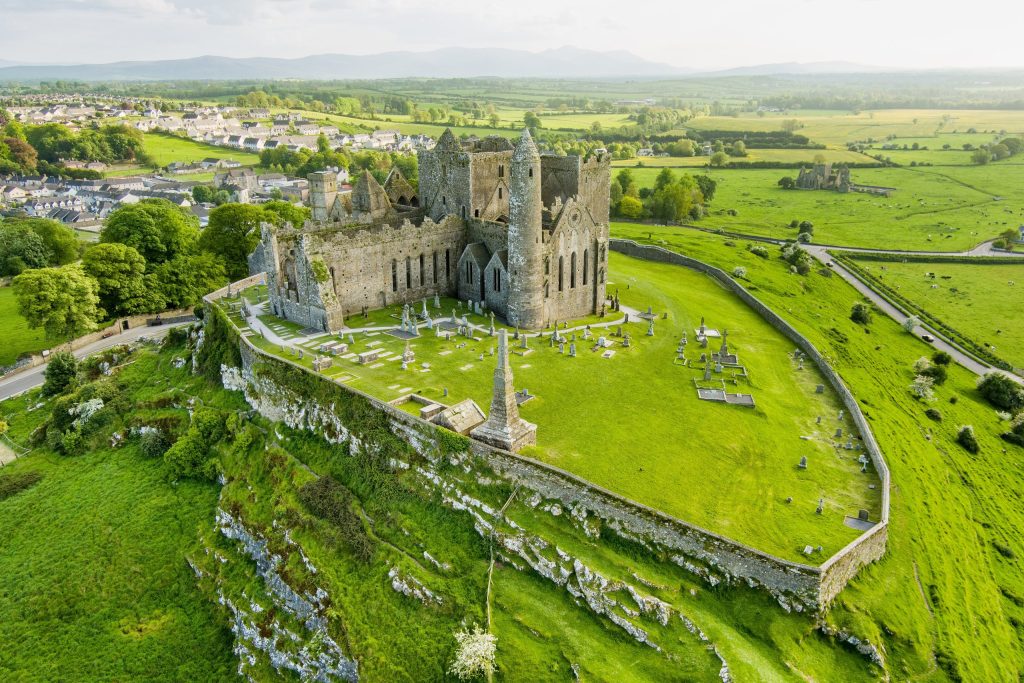
The first time you see the Rock of Cashel, you understand why it became the seat of kings. Rising 200 feet above the Golden Vale of County Tipperary, this limestone outcrop crowned with medieval ruins commands the landscape for miles around. It’s not just impressive—it’s magnetic, drawing your eye across fields and farms to its unmistakable silhouette against the sky.
Watch: the latest film
The Irish County Names: What All 32 Mean
This is where Irish high kings ruled for nearly 900 years before handing the fortress to the church. Today, the Rock of Cashel stands as one of Ireland’s most complete and evocative medieval sites, combining architectural grandeur with a location that still takes your breath away.
What You’ll Find at the Summit
The walk up to the Rock takes you through the modern town of Cashel, past shops and cafes, before the path turns upward. At the top, you’re greeted by a cluster of limestone structures that span five centuries of Irish history.
The round tower, built around 1100, is the oldest survivor—a 90-foot sentinel that once served as both bell tower and refuge. Next to it stands the roofless Cathedral of St. Patrick, a 13th-century Gothic masterpiece with pointed arches and carved details that have weathered 800 Irish winters. The Hall of the Vicars Choral, restored and still roofed, gives you a sense of what these buildings looked like when they were living, working spaces.
But it’s Cormac’s Chapel that stops most visitors in their tracks. Completed in 1134, this Romanesque gem is considered the finest of its kind in Ireland. The twin towers, the carved tympanum over the doorway, the ribbed stone ceiling inside—every detail speaks to the ambition and skill of its builders. Stand inside and look up at the barrel-vaulted roof, one of the oldest stone roofs in Ireland still intact.
The View From the Top
History aside, the Rock of Cashel offers something you won’t find in most Irish heritage sites: a panoramic view that stretches across three counties. From the cathedral walls, you can see the Galtee Mountains to the south, the fields of the Golden Vale spreading in every direction, and on clear days, the distant peaks of the Knockmealdown range.
This vantage point explains everything. You can see why the kings of Munster chose this spot, why St. Patrick himself is said to have visited in 450 AD, why control of the Rock meant control of the region. Geography and power are written into every stone.
The site is managed by the Office of Public Works and includes excellent interpretive displays in the entrance building. Admission runs about $10 for adults, with family and group rates available. Audio guides are included, and guided tours run throughout the day during peak season.
Making the Most of Your Visit
The Rock of Cashel sits just off the main Dublin-Cork road, making it an easy stop on a longer Irish journey. The town of Cashel itself deserves an hour or two—there are good cafes along Main Street, and the Cashel Folk Village offers a glimpse into 18th and 19th-century Irish life.
Plan to spend at least 90 minutes at the Rock itself. Come early in the morning or late in the afternoon to avoid tour groups and to catch the best light for photographs. The site is exposed to wind and rain, so bring layers even in summer.
If you have time, walk around the base of the Rock on the path that circles the outcrop. From below, looking up at the limestone cliff and medieval silhouette, you’ll get the view that travelers have been admiring for a thousand years.
About eight miles away, the ruins of Hore Abbey sit in a field beneath the Rock—a 13th-century Cistercian monastery that’s free to explore and offers one of the best views back toward Cashel. It’s a quiet spot that sees far fewer visitors than the Rock itself.
Why It Matters
The Rock of Cashel represents something essential about Irish heritage: the layering of story upon story, century upon century, all in one place. It was a fortress before it was a monastery. It hosted Brian Boru, the high king who defeated the Vikings. It survived Cromwell’s armies and centuries of abandonment. And now it stands, roofless but unbroken, as a reminder of what Ireland has endured and preserved.
This isn’t a reconstruction or a ruin that’s been tidied up beyond recognition. The Rock of Cashel is raw, weathered, and real—a place where you can still feel the weight of history in the stone beneath your feet and the wind that’s been blowing across Tipperary for as long as these walls have stood.
Ready to explore more of Ireland’s most unforgettable places? Download the free guide “The Ireland Bucket List: 25 Places That Will Stop You In Your Tracks” at irishvideos.com/subscribe, and watch stunning videos of Ireland on the Love Ireland channel at YouTube.