
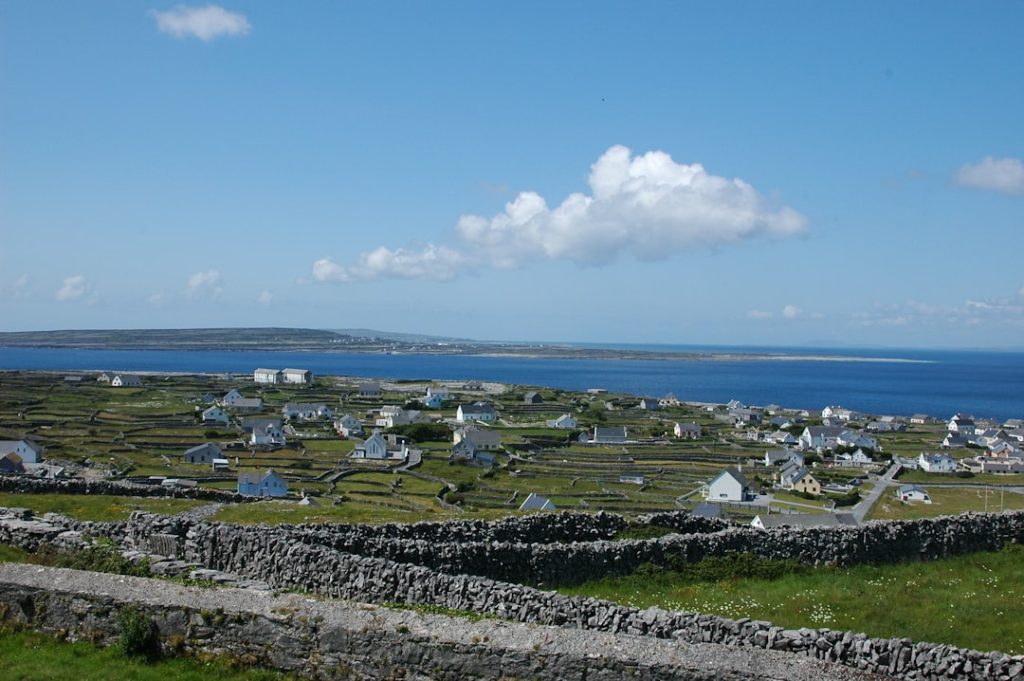
The three Aran Islands—Inis Mór, Inis Meáin, and Inis Oírr—rise from the Atlantic off the coast of County Galway like fragments of ancient Ireland preserved in stone and sea spray. These limestone islands are home to prehistoric forts, Irish-speaking communities, hand-knit sweaters, and landscapes so stark and beautiful they’ve drawn writers, artists, and travelers for generations.
Watch: the latest film
Dun Aonghasa: The Irish Fort With No Back Wall (True Story)
Visiting the Aran Islands isn’t a quick detour. It requires a ferry ride or short flight, a willingness to slow down, and an appreciation for what makes these islands distinct from the rest of Ireland. Here’s what you need to know before you go.
Choosing Your Island
Each of the three islands has its own character. Inis Mór is the largest and most visited, home to Dún Aonghasa, a semicircular stone fort perched on sheer cliffs 300 feet above the Atlantic. The fort dates back over 2,000 years and offers one of the most dramatic viewpoints in Ireland. Inis Mór also has the most visitor infrastructure, including bike rentals, pony traps, minibuses, cafés, and several guesthouses.
Inis Meáin, the middle island, is the quietest. It’s home to around 150 people, many of whom still speak Irish as their first language. There are no large tour groups here, just stone walls, traditional thatched cottages, and a knitwear company that produces some of the finest Aran sweaters you’ll find anywhere. The playwright J.M. Synge spent summers on Inis Meáin, and his cottage still stands near the island’s center.
Inis Oírr, the smallest island, strikes a balance between the two. It’s compact enough to explore on foot, with a shipwreck half-buried in sand, a 15th-century castle, and a small but lively pub culture. Day-trippers from Doolin often choose Inis Oírr for its manageable size and relaxed atmosphere.
Getting There and Getting Around
Ferries to the Aran Islands depart year-round from Rossaveal in Connemara and seasonally from Doolin in County Clare. The crossing from Rossaveal to Inis Mór takes about 40 minutes and costs around $30 round trip. Ferries from Doolin are shorter but more weather-dependent. You can also fly from Connemara Airport on a small propeller plane—a nine-minute flight that offers stunning aerial views of the Cliffs of Moher and the islands themselves. Flights run around $50 each way.
Once on the islands, most visitors rent bicycles to explore. Inis Mór is about eight miles long, and cycling lets you reach the island’s main sites at your own pace. Pony traps and minibus tours are also available if you prefer a guided experience. On Inis Oírr, you can walk the entire island in a few hours. Inis Meáin is best explored slowly, on foot, with no agenda beyond following the stone walls and clifftop paths.
What to See and Do
Dún Aonghasa on Inis Mór is the most famous site, but it’s far from the only one. The island is dotted with smaller stone forts, early Christian churches, and holy wells. The Seven Churches (Na Seacht dTeampaill) is a monastic settlement with carved stone crosses and gravestones etched with Celtic designs. The Poll na bPéist, or Wormhole, is a natural rectangular pool carved into the limestone where the Red Bull Cliff Diving World Series has been held.
On Inis Oírr, visit the Plassey shipwreck, a cargo vessel driven ashore during a 1960 storm and now rusting on the rocks. The 14th-century O’Brien’s Castle sits on the island’s highest point, offering views across to the Cliffs of Moher. St. Cavan’s Church is a tiny stone chapel half-buried in sand dunes, one of the most photographed spots on the island.
Inis Meáin’s appeal is less about specific landmarks and more about immersion. Walk the green roads, watch the waves break against the cliffs, and visit Teach Synge, the restored cottage where the playwright lived. If you’re lucky, you might catch a céilí or trad session in one of the island’s small community halls.
Practical Tips
Bring layers. The islands are exposed to Atlantic winds, and weather can shift quickly from sun to rain and back again. Waterproof jackets and sturdy walking shoes are essential. There are no ATMs on Inis Meáin or Inis Oírr, so bring cash. Inis Mór has one ATM, but it’s wise not to rely on it.
If you’re planning to stay overnight, book ahead, especially in summer. Guesthouses and B&Bs fill up quickly, and the islands’ remoteness means last-minute options are limited. Staying overnight gives you the chance to experience the islands after the day-trippers leave—quiet evenings in the pub, long walks at dusk, and mornings when the stones and sea are yours alone.
Irish is the primary language on the islands, though everyone speaks English. You’ll hear Irish in the shops, schools, and homes, and it’s part of what makes the Aran Islands feel like a living link to Ireland’s past.
The Aran Islands aren’t for everyone. If you want bustling towns and packed itineraries, you’ll find them too quiet. But if you’re drawn to wild beauty, ancient history, and the feeling of standing at the edge of the world, the Arans deliver something unforgettable.
If Ireland has a hold on you, two things are worth your time. First, our free guide The Ireland Bucket List — 25 places that will stop you in your tracks, sent straight to your inbox. Second, the Love Ireland channel on YouTube, where we tell the stories behind these places in short films.