
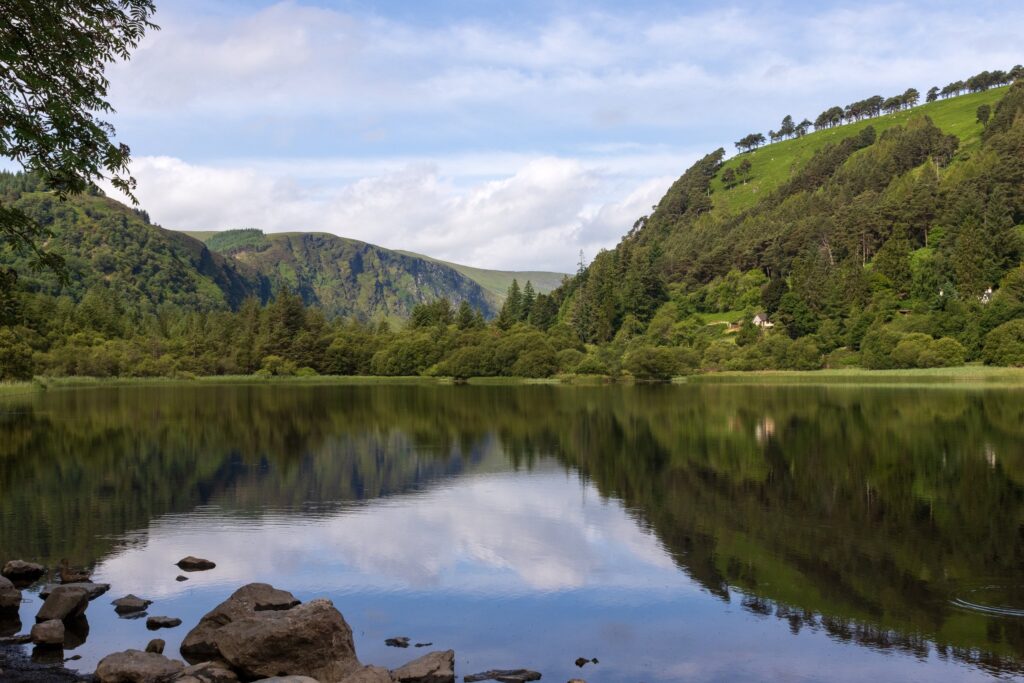
There’s a reason Glendalough remains one of Ireland‘s most visited heritage sites. This 6th-century monastic settlement, founded by St. Kevin in a remote Wicklow valley, offers something rare: a place where ancient history, spiritual atmosphere, and raw natural beauty meet in perfect harmony.
Watch: the latest film
Dun Aonghasa: The Irish Fort With No Back Wall (True Story)
The name means “Valley of the Two Lakes” in Irish, and those glacial waters — the Upper and Lower Lakes — give the site its serene, almost otherworldly quality. Add a round tower, stone churches, Celtic crosses, and forested mountain trails, and you have one of the most complete and atmospheric monastic sites in all of Ireland.
The Monastic Settlement and Round Tower
St. Kevin came to Glendalough around 550 AD seeking solitude. He found it in a cave above the Upper Lake, now known as St. Kevin’s Bed. What began as a hermitage grew into one of Ireland’s great centers of learning, attracting scholars and pilgrims from across Europe for over 600 years.
The round tower, standing 110 feet tall, is the site’s most iconic structure. Built around the 10th century, it served as a bell tower, a beacon, and a refuge during Viking raids. The doorway sits several feet above ground — a ladder would have been pulled up when danger approached. It’s one of the best-preserved round towers in Ireland, and you can still see the skill and precision in the stonework.
Nearby stands the cathedral, the largest of the seven churches at Glendalough. Though roofless now, its walls and Romanesque chancel arch remain intact. The graveyard surrounding it is still in use, connecting the living to centuries of pilgrimage and prayer.
St. Kevin’s Church and the Priest’s House
St. Kevin’s Church, often called St. Kevin’s Kitchen because of its stone roof and chimney-like bell tower, is one of the most photographed buildings in Ireland. It dates to the 11th century and is remarkably intact, with a steep stone roof that has survived nearly a thousand years of Wicklow weather.
The Priest’s House, a small Romanesque building near the entrance, was likely used to house relics of St. Kevin. Its carved stone doorway and round-headed window are fine examples of early Irish ecclesiastical architecture. Stand here long enough, and you’ll start to feel the weight of history — the generations who walked these same paths, seeking meaning, solace, or sanctuary.
The Upper Lake and Woodland Walks
Most visitors explore the monastic site near the visitor center and Lower Lake, but the real magic happens when you follow the path west toward the Upper Lake. This is where St. Kevin lived in his cave, and where the valley narrows into a gorge framed by steep, wooded slopes.
The 1.5-mile Green Road trail follows the lakeshore and connects the two lakes. It’s an easy, peaceful walk through oak and birch forest, with the water glinting through the trees. If you’re looking for more, the Spink and Glenealo Valley Loop is a moderate 7-mile hike that climbs the ridge above the Upper Lake, offering stunning views down into the valley.
In early morning or late afternoon, when the tour buses have left, the Upper Lake feels timeless. Mist rises off the water, deer move quietly through the woods, and you understand exactly why Kevin chose this place.
Practical Tips for Your Visit
Glendalough is about 30 miles south of Dublin, easily reached by car in under an hour. There’s also a daily bus service from the city. Parking costs around $6 USD and can fill up quickly in summer and on weekends — arrive early or visit midweek if you can.
The visitor center offers exhibits on monastic life, the flora and fauna of the valley, and the geology that shaped it. Admission is about $5 USD for adults. The monastic site itself is free to explore and open year-round.
Wear good walking shoes. Even if you’re just exploring the main site, the ground is uneven and often damp. If you’re hiking, bring layers — the weather in Wicklow changes fast.
The Glendalough Hotel, just outside the entrance, is a solid choice for lunch or a pint after your visit. The Wicklow Heather restaurant serves hearty Irish fare, and the bar has a cozy fire most days of the year.
Why Glendalough Matters
Glendalough isn’t just a ruin. It’s a living connection to Ireland’s golden age of monasticism, when Irish monks preserved learning through Europe’s Dark Ages and created manuscripts like the Book of Kells. It’s also a reminder that Ireland’s saints weren’t distant figures — they were real people who sought beauty, silence, and purpose in wild places.
Whether you come for the history, the hiking, or simply to stand beside an ancient round tower in a glacial valley, Glendalough delivers. It’s one of those places that stays with you long after you leave.
Want more inspiration for your Ireland journey? Download the free guide The Ireland Bucket List: 25 Places That Will Stop You In Your Tracks at irishvideos.com/subscribe, and be sure to watch stunning videos of Ireland on the Love Ireland YouTube channel.