
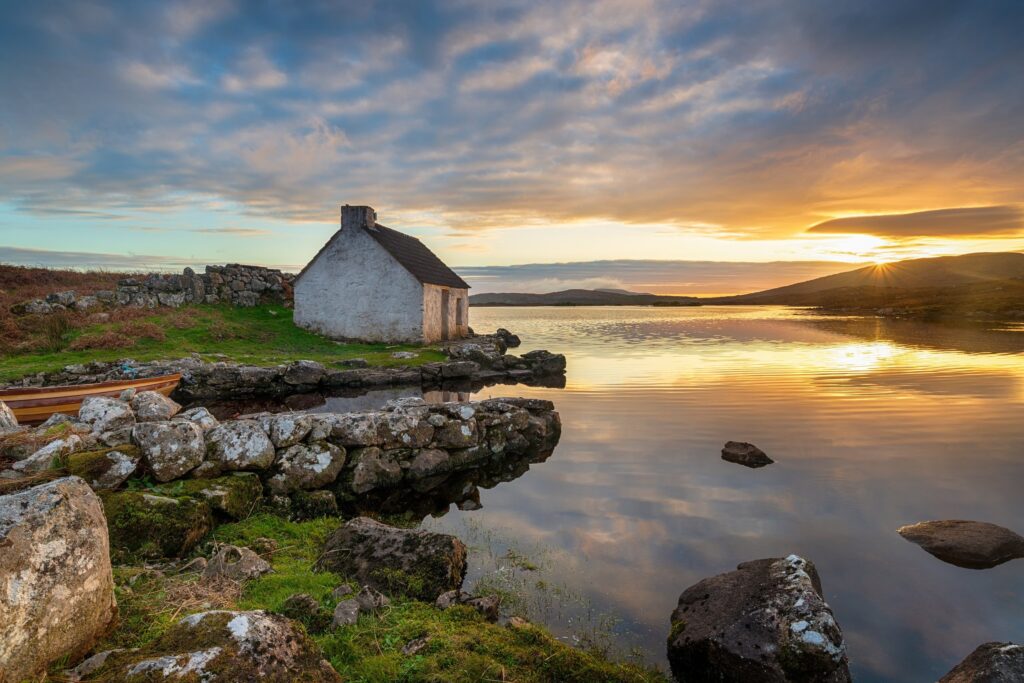
Connemara doesn’t reveal itself all at once. You drive west from Galway, and gradually the hedgerows give way to stone walls, the fields turn to blanket bog, and the sky seems to grow wider. By the time you reach the heart of this rugged region in County Galway, you’re in a landscape that feels ancient, elemental, and utterly unlike anywhere else in Ireland.
Watch: the latest film
The Irish County Names: What All 32 Mean
This is a place where the light changes by the minute, where mountains rise from bogs, and where the Irish language is still spoken in daily life. Connemara is wild, remote, and achingly beautiful — and it stays with you long after you’ve left.
The Mountains, Bogs, and Stone Walls
The Twelve Bens — also called the Twelve Pins — dominate the interior of Connemara. These rugged quartzite peaks rise sharply from the surrounding bogland, their summits often shrouded in mist. Benbaun, the highest at 2,395 feet, offers sweeping views over Kylemore, Inagh Valley, and the Atlantic beyond. The mountains aren’t enormous by global standards, but their presence in this low, open landscape makes them unforgettable.
Between the mountains lie vast stretches of blanket bog — wet, peaty ground dotted with heather, sedge, and pools of dark water. The bogs are crossed by narrow roads and ancient pathways, and they’re home to a surprising variety of wildlife, including skylarks, merlins, and the occasional red deer. In late summer, the bog cotton blooms, turning the landscape into a field of white tufts that move in the wind like ghosts.
And then there are the stone walls. They run everywhere in Connemara — over hills, across bogs, along the coast. Built without mortar from the stones cleared from fields, these walls tell the story of generations of hard work in difficult land. They’re beautiful in their functionality, and they give the landscape a quiet, timeless character.
Kylemore Abbey and the Quiet Valleys
Kylemore Abbey sits on the shore of Pollacapall Lough, backed by wooded mountains and framed by one of the most photographed views in Ireland. Built in the 1860s as a romantic castle, it became a Benedictine monastery in 1920 and remains home to a community of nuns today. Visitors can tour the abbey, stroll through the restored Victorian walled garden, and walk the lakeshore paths.
But Kylemore’s real draw is its setting. The building is stunning, but it’s the landscape around it — the still water, the dense woods, the grey peaks above — that makes it feel like something from a fairy tale.
Just to the south lies the Inagh Valley, a glacial trough that cuts between the Twelve Bens and the Maamturk Mountains. The valley is remote and quiet, with a single narrow road running through it. Stop anywhere along that road, and you’ll be surrounded by silence, stone, and sky. It’s one of the most peaceful places in Ireland.
Roundstone, Clifden, and the Atlantic Edge
Connemara’s coastline is as dramatic as its interior. The town of Roundstone sits on a sheltered harbor beneath Errisbeg Mountain, a low peak that offers one of the best short hikes in the west. The village itself is small and charming, with colorful shopfronts, a working harbor, and Malachy Kearns’s bodhran workshop, where traditional Irish drums are still made by hand.
Clifden, often called the capital of Connemara, is a lively market town with a strong music scene, good restaurants, and easy access to the Sky Road — a looping coastal drive that offers jaw-dropping views over Clifden Bay and the Atlantic. The road climbs high above the water, passing stone cottages, grazing sheep, and fields that slope down to rocky shores.
Further west, the Coral Strand at Carraroe is made not of sand but of tiny fragments of red coralline algae, giving the beach a pale pink hue. It’s quiet, windswept, and otherworldly — a perfect example of Connemara’s ability to surprise you around every bend.
Why Connemara Feels Different
Part of what makes Connemara so compelling is its remoteness. This is still a working landscape, where farmers raise sheep on thin soil, where turf is cut from the bog, and where Irish — not English — is the first language in many communities. The Gaeltacht culture here is alive and strong, and you’ll hear it in the pubs, on the radio, and in everyday conversation.
The weather plays a role, too. Connemara is famously changeable. You might have sunshine, rain, wind, and mist all in the same hour. The shifting light transforms the landscape constantly — one moment the mountains are sharp and clear, the next they’re veiled in cloud. That unpredictability is part of the magic.
And then there’s the feeling of space. Connemara is never crowded. Even in summer, you can walk a mountain trail or drive a bog road and see no one for hours. It’s a place to breathe, to think, to be quiet. It’s a place that invites slowness.
How to Experience It
Connemara rewards those who take their time. Spend at least two or three days here if you can. Base yourself in Clifden, Roundstone, or Letterfrack, and explore by car or bike. Hike one of the Twelve Bens — Diamond Hill in Connemara National Park is a great introduction. Drive the Sky Road at sunset. Visit Kylemore Abbey early in the morning before the crowds arrive.
Stop in the small villages. Have a pint in a pub where the locals still speak Irish. Buy a loaf of brown bread from a village shop. Walk a beach with no footprints but your own. Connemara isn’t a place you tick off a list — it’s a place you let sink in.
Ready to plan your Irish adventure? Download the free guide The Ireland Bucket List: 25 Places That Will Stop You In Your Tracks and get inspired by stunning videos on the Love Ireland channel on YouTube.