
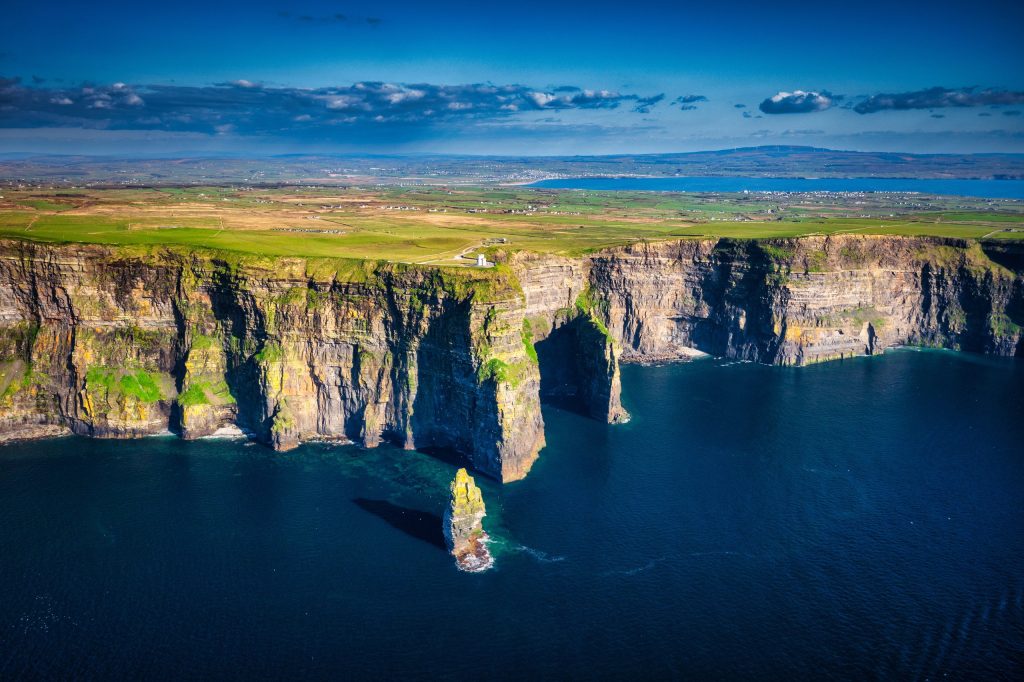
The Cliffs of Moher draw nearly a million visitors each year, and most spend less than an hour there. They park at the visitor center, walk to O’Brien’s Tower, snap a few photos of the 700-foot sea cliffs stretching along the Atlantic, and move on. It’s a beautiful hour, but it barely scratches the surface of what these cliffs offer.
Watch: the latest film
The Irish County Names: What All 32 Mean
If you give the Cliffs of Moher a full day, you’ll discover something entirely different: quiet walking trails, nesting seabirds, hidden viewpoints, and the kind of coastal drama that stays with you long after you leave County Clare.
Start Early at the Visitor Center
Arrive at the official Cliffs of Moher Visitor Experience by 9 a.m., before the tour buses roll in. The parking fee is around $8 per person, and it includes access to the excellent underground visitor center built into the hillside. Don’t skip it—the exhibits on the geology, history, and wildlife of the cliffs are surprisingly engaging, especially the footage of puffins, razorbills, and peregrine falcons that nest along the cliff faces from April through July.
From the visitor center, walk north along the paved cliff-edge path toward O’Brien’s Tower. This stone lookout, built in 1835 by local landlord Cornelius O’Brien, offers sweeping views south to the Twelve Bens of Connemara and north to the Aran Islands. On a clear day, you can see Loop Head far to the south and the hills of Galway Bay stretching into the distance.
Take the Coastal Walk to Hag’s Head
Here’s where most people turn around. Don’t. Continue south on the cliff path beyond the crowds, and you’ll find yourself almost alone. The trail runs for about three miles to Hag’s Head, the southern tip of the cliffs, where the rock formation resembles a woman’s profile gazing out to sea—the origin of its name in Irish folklore.
This walk takes you along less-traveled sections of the cliff edge, where the land falls away in sheer drops to the churning Atlantic below. The path is well-maintained but uneven in places, so wear sturdy shoes. Along the way, watch for wildflowers clinging to the rocks—sea thrift, bladder campion, and bird’s-foot trefoil in spring and summer.
Hag’s Head itself is quieter, wilder, and in many ways more dramatic than the main viewing areas. There’s a Napoleonic-era signal tower here, one of many built along Ireland’s coast in the early 1800s. Sit for a while, listen to the waves, and take in the solitude.
Walk North to Doolin for a Different Perspective
If you’d rather head north, the cliff path continues for five miles toward the village of Doolin. This route is equally stunning and takes you past the cliffs’ highest point—702 feet above sea level. The landscape shifts as you walk: rocky headlands, grassy plateaus, and sudden glimpses of the ocean crashing against sea stacks far below.
This trail is part of the Burren Way, a longer hiking route that winds through County Clare. It’s well-marked and mostly level, though it can be exposed to wind. Bring layers, even in summer.
Finish in Doolin, where you can reward yourself with lunch at one of the village pubs—Gus O’Connor’s, McDermott’s, or McGann’s—and catch a trad session if you’re there in the evening. If you’ve parked at the main visitor center, you can either walk back (it’s about 10 miles round trip) or arrange a taxi to return you to your car.
Watch the Light Change
One of the best reasons to spend a full day at the Cliffs of Moher is the light. Morning light is soft and golden, perfect for photography and birdwatching. Midday can be harsh, but the cliffs take on a stark, dramatic quality. Late afternoon and early evening bring the magic: the sun lowers over the Atlantic, casting long shadows across the cliffs and turning the ocean a deep, shifting blue.
If you’re visiting in summer, the days are long, and sunset doesn’t arrive until after 10 p.m. Stay late, and you’ll have the cliffs nearly to yourself as the crowds thin out and the landscape takes on an otherworldly glow.
Respect the Edge
A word of caution: the cliffs are beautiful, but they’re also dangerous. Stay behind the stone walls and warning signs. Every year, people are injured or worse by venturing too close to the edge, especially in windy conditions. The rock can be unstable, and gusts can come out of nowhere. Respect the Atlantic—it’s not a backdrop, it’s a force.
The Cliffs of Moher are one of Ireland’s most iconic landmarks for good reason. But they’re not a quick stop. Give them time, walk the trails, watch the birds, and let the scale and beauty of this place settle in. You’ll leave with more than photos—you’ll leave with a sense of Ireland’s wild, ancient edge.
Ready to explore more of Ireland’s unforgettable places? Download the free guide The Ireland Bucket List: 25 Places That Will Stop You In Your Tracks and watch more stunning Irish landscapes on the Love Ireland channel on YouTube.