
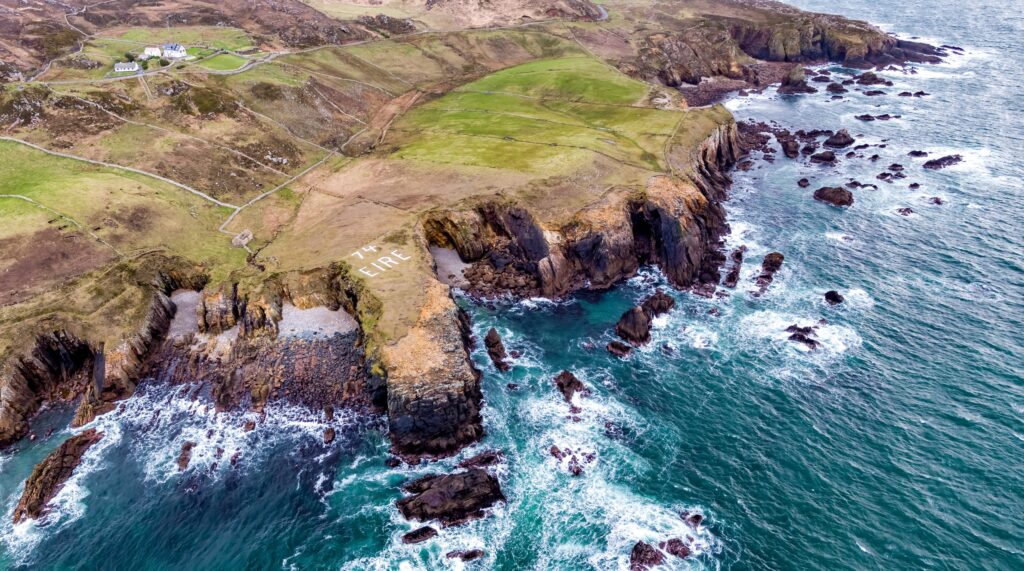
The Wild Atlantic Way isn’t just a coastal drive. It’s 1,600 miles of raw beauty, ancient history, and living culture strung along Ireland’s entire western edge, from Kinsale in County Cork to Malin Head in County Donegal. It’s the world’s longest defined coastal touring route, and it delivers everything that makes Ireland magnetic: towering sea cliffs, hidden beaches, stone-walled fields, whitewashed villages, and pubs where the music starts at nine and doesn’t stop till closing.
Watch: the latest film
Dun Aonghasa: The Irish Fort With No Back Wall (True Story)
Whether you have a week or a month, the Wild Atlantic Way rewards every mile with something worth remembering.
The Landscape That Stops You Cold
The west coast of Ireland faces the full force of the Atlantic, and you feel it everywhere. At the Cliffs of Moher in County Clare, the land drops 700 feet straight into churning water. At Slieve League in County Donegal, the cliffs rise nearly three times higher, among the tallest sea cliffs in Europe. Between them, you’ll find Connemara’s wild boglands, the lunar limestone of the Burren, the golden strands of Inch Beach in Kerry, and the jagged peninsulas of Beara and Sheep’s Head.
Every stretch offers pull-offs where you can step out, breathe salt air, and take in views that belong on postcards but feel better in person. The light changes by the hour. Rain sweeps in from the west, then clears to reveal rainbows over stone ruins and grazing sheep. It’s the Ireland people dream about.
Villages Worth Slowing Down For
The Wild Atlantic Way threads through dozens of villages and towns, each with its own character. Dingle, at the tip of the Dingle Peninsula, is a hub of traditional music, colorful shopfronts, and seafood restaurants serving the day’s catch. Westport in County Mayo combines Georgian architecture with a lively pub scene and access to Croagh Patrick, Ireland’s holy mountain.
Further north, Clifden anchors Connemara with its two church spires and surrounding hills. Sligo town opens the door to Yeats Country, where the poet’s landscapes still inspire. And tiny Allihies on the Beara Peninsula, with its cluster of painted houses and old copper mines, feels like the edge of the world in the best way.
These aren’t just places to pass through. They’re where you linger over coffee, strike up conversations, and stumble into evening trad sessions that remind you why Ireland’s culture is still so alive.
Experiences You Can’t Find Anywhere Else
Driving the Wild Atlantic Way means choosing your own adventure. You can hike the cliff paths at Loop Head, kayak around the sea stacks of Downpatrick Head, or take a boat to the Aran Islands or Skellig Michael. You can explore Dunguaire Castle overlooking Galway Bay, walk among the beehive huts of the Dingle Peninsula’s ancient monastic settlements, or visit the Quiet Man cottage in Cong.
Surfers head to Lahinch, Bundoran, and Mullaghmore for some of Europe’s best waves. Birdwatchers flock to the cliffs and islands to see puffins, gannets, and razorbills. And everyone, eventually, ends up in a pub with a peat fire, a pint, and a fiddle player in the corner.
The route is designed to be flexible. Official Discovery Points mark key stops, but some of the best moments happen when you follow a sign down a narrow road to a ruined abbey, a hidden beach, or a craft workshop tucked into a barn.
Planning Your Journey
Most travelers tackle the Wild Atlantic Way in sections. The southern stretch from Kinsale to Dingle covers County Cork and Kerry, with dramatic peninsulas and famous stops like the Ring of Kerry and Mizen Head. The middle section runs through Clare, Galway, and Mayo, taking in the Cliffs of Moher, Connemara, and Achill Island. The northern stretch covers Sligo, Leitrim, and Donegal, where the crowds thin and the landscape grows even wilder.
Allow at least a week if you’re covering significant ground, and two or three if you want to explore deeply. Rent a car with good handling—roads can be narrow and winding, especially on the peninsulas. Book accommodations ahead in summer, but leave room for spontaneity. Some of the best finds come from unplanned detours.
Pack layers. Weather changes fast on the Atlantic coast, and you’ll want a rain jacket even in July. Bring a good camera, but don’t forget to put it down and simply watch the waves, the light, and the life unfolding around you.
The Wild Atlantic Way isn’t a race. It’s an invitation to see Ireland at its most dramatic, most welcoming, and most real. Download the free guide The Ireland Bucket List: 25 Places That Will Stop You In Your Tracks to start planning your route, and subscribe to the Love Ireland channel on YouTube for videos that bring the coast to life before you even pack your bags.