
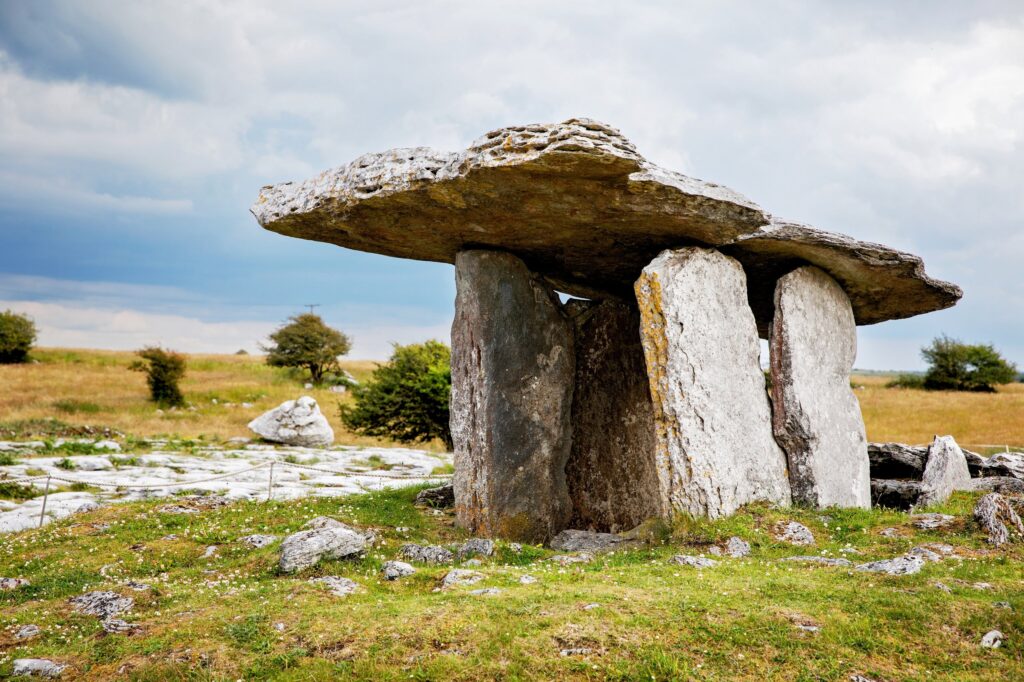
In the Boyne Valley, just north of Dublin, three massive passage tombs rise from the farmland like monuments from another world. Newgrange, Knowth, and Dowth — together known as Brú na Bóinne — were built more than 5,000 years ago, making them older than Stonehenge and the Great Pyramid of Giza. These structures are not just burial mounds. They’re feats of engineering, astronomical observatories, and windows into a culture that thrived in Ireland long before the Celts arrived.
Watch: the latest film
Dun Aonghasa: The Irish Fort With No Back Wall (True Story)
The Wonder of Newgrange
Newgrange is the star of Brú na Bóinne, and for good reason. This passage tomb is about 250 feet in diameter and stands nearly 45 feet tall. Its exterior is faced with brilliant white quartz, which would have gleamed across the valley when it was first built around 3200 BC. The entrance is marked by a massive stone carved with spirals, one of the finest examples of Neolithic art in Europe.
But the real magic happens once a year, on the winter solstice. For about 17 minutes at dawn, sunlight streams through a roof-box above the entrance and illuminates the inner chamber — a feat of precise astronomical alignment that still astonishes archaeologists and visitors alike. If you want to witness this event in person, you’ll need to enter the annual lottery, as only a small number of people are allowed inside each year. The odds are steep, but the experience is unforgettable.
Even if you visit on an ordinary day, the guided tour inside Newgrange is extraordinary. You’ll walk down the 60-foot passage into the central chamber, where the guide will turn off the lights and simulate the solstice sunrise. It’s a powerful, moving moment that connects you to the people who built this place millennia ago.
Knowth: Art and Archaeology
While Newgrange gets the most attention, Knowth is equally remarkable — and in some ways, even more impressive. This tomb contains more than half of all the Neolithic art found in Western Europe, with over 200 decorated stones covered in spirals, circles, zigzags, and other mysterious symbols. Some are tucked into the passage walls; others are hidden in places only archaeologists have seen.
Knowth is actually a complex of monuments. The main mound has two passages, one aligned to the spring and autumn equinoxes, and it’s surrounded by 17 smaller satellite tombs. Excavations here have revealed layers of history — from Neolithic builders to early Christian monks who used the mound as a settlement.
Unlike Newgrange, you can’t go inside the main passages at Knowth, but you can walk around the exterior and view some of the carved stones up close. The scale and artistry are breathtaking, and the interpretive panels help you understand the significance of what you’re seeing.
Dowth: The Quiet Third
Dowth is the least visited of the three tombs, partly because it’s not included in the main visitor center tours and partly because it’s not as dramatically restored. But that’s exactly why some people prefer it. Dowth feels more untouched, more atmospheric. You can walk right up to it on your own, and there’s a sense of mystery that’s harder to find at the more polished sites.
Like Knowth, Dowth has two internal chambers. One is aligned to the setting sun on the winter solstice, while the other is less clearly oriented. The mound is also decorated with carved stones, though fewer have survived in good condition. If you’re visiting Brú na Bóinne and have time, the walk to Dowth along the Boyne is well worth it.
Visiting Brú na Bóinne
All visits to Newgrange and Knowth must begin at the Brú na Bóinne Visitor Centre, located on the south bank of the River Boyne near Donore in County Meath. From there, a shuttle bus takes you across the river to the monuments. Tickets cost around $15 USD for adults, and it’s highly recommended to book online in advance, especially during the summer months and around the solstices.
The visitor center itself is excellent, with exhibits on Neolithic life, the construction of the tombs, and the context of the Boyne Valley in Irish prehistory. There’s also a full-scale replica of the Newgrange chamber, so even if you can’t get inside the real thing, you can still experience the layout and the carvings.
Plan to spend at least half a day here. If you’re fascinated by ancient history or archaeology, you could easily spend longer. The landscape itself — rolling green hills dotted with hawthorn and the gentle curve of the Boyne — is beautiful and peaceful, a fitting setting for one of the most important ancient sites in the world.
Ready to dive deeper into Ireland’s most iconic places? Download the free guide The Ireland Bucket List: 25 Places That Will Stop You In Your Tracks and start planning your journey. And for more stories, scenery, and the spirit of Ireland, subscribe to the Love Ireland channel on YouTube.